1771 Bonne Map of Abyssinia Ethiopia Sudan and the Red Sea
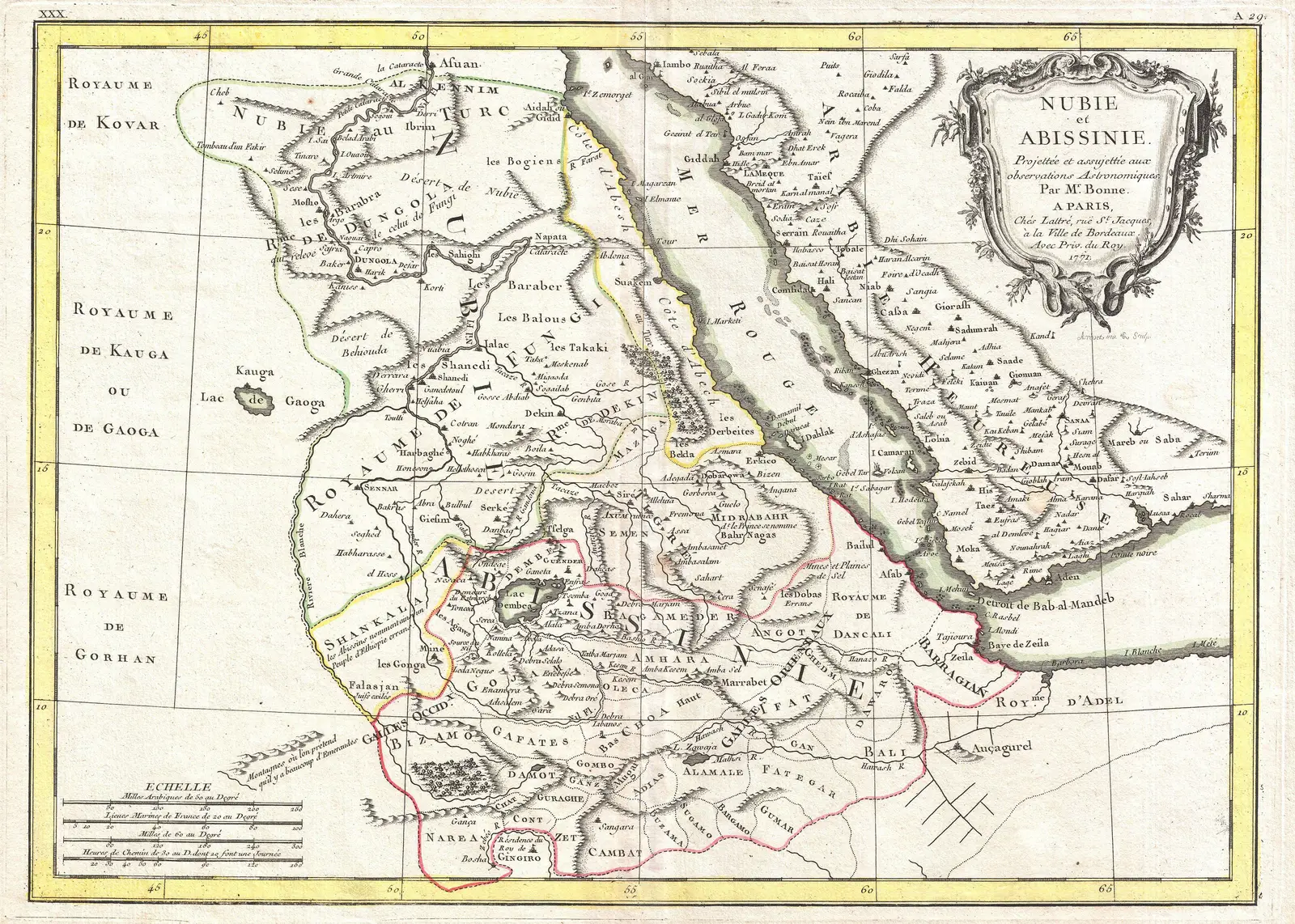
Click or tap the map to enlarge it.
Key Takeaways:
- The 1771 Bonne Map of Abyssinia, Ethiopia, Sudan, and the Red Sea is a significant cartographic representation of the region during that time.
- This map provides valuable insights into the geography, settlements, and coastal features of the area.
- It offers a historical perspective on how the region was perceived in the 18th century.
- The detailed illustrations and descriptions on the map make it a valuable resource for historians, geographers, and enthusiasts.
- The map highlights the importance of understanding historical cartography for research, preservation, and exploration.
History
The 1771 Bonne Map of Abyssinia, Ethiopia, Sudan, and the Red Sea, created by Rigobert Bonne, is an essential piece of cartographic history. Cartography, the science and art of mapmaking, has always played a crucial role in understanding our world.
During the 18th century, exploration and discovery were at their peak. European nations were engaged in exploring various parts of the globe, including Africa. The fascination with Africa led to numerous maps being created, documenting the land, geography, and resources of the continent.
Rigobert Bonne, a French cartographer, was one of the prominent mapmakers of his time. His maps were known for their accuracy and attention to detail. The 1771 Bonne Map of Abyssinia, Ethiopia, Sudan, and the Red Sea is a testament to his cartographic skills and dedication.
Unique Insights
1. Coastal Features: The map provides a unique perspective on the coastal features of the Red Sea, showcasing various ports, capes, and islands along the coastline. This information can be valuable for understanding historical maritime trade routes and navigation.
2. Settlements: The map depicts the major settlements and cities of Abyssinia, Ethiopia, and Sudan during the 18th century. It allows us to visualize how these regions were organized and interconnected.
3. Geographical Details: With detailed topographic information, the map offers insights into the physical features of the land, including rivers, mountains, and deserts. Such details were vital for explorers, traders, and researchers at that time.
4. Cultural Significance: By studying the map, we gain insights into the cultural heritage of the region. The locations of ancient cities, religious sites, and landmarks provide clues about the historical importance and influence of various civilizations within Abyssinia and Ethiopia.
Table of Relevant Facts
| Year | Event |
|---|---|
| 1771 | Rigobert Bonne creates the Bonne Map of Abyssinia, Ethiopia, Sudan, and the Red Sea. |
| 18th century | Exploration and discovery expeditions reached their peak. |
| 18th century | Europeans’ fascination with Africa leads to the creation of numerous maps. |
| 18th century | Significant growth in trade and colonial influences in Africa. |
FAQ
-
What is the significance of the 1771 Bonne Map of Abyssinia, Ethiopia, Sudan, and the Red Sea?
The map provides valuable insights into the geography, settlements, and coastal features of the region during the 18th century. It offers a historical perspective and serves as a valuable resource for researchers and enthusiasts.
-
Who created the 1771 Bonne Map of Abyssinia, Ethiopia, Sudan, and the Red Sea?
The map was created by Rigobert Bonne, a renowned French cartographer known for his accuracy and attention to detail.
-
What unique insights does this map offer?
The map provides insights into coastal features, settlements, geographical details, and cultural significance of the region during the 18th century.
-
Are there any historical events associated with the map?
Although the map itself does not represent specific historical events, it reflects the time of exploration, trade, and colonial influences in Africa during the 18th century.
-
What can we learn about ancient civilizations from this map?
The locations of ancient cities, religious sites, and landmarks depicted on the map provide insights into the cultural heritage and historical importance of various civilizations within Abyssinia and Ethiopia.
-
Why is studying historical cartography important?
Studying historical cartography is essential for research, preservation, and exploration. It provides valuable information about the past and helps us understand how our understanding of the world has evolved over time.
-
How can the 1771 Bonne Map of Abyssinia, Ethiopia, Sudan, and the Red Sea be utilized today?
The map can be used by historians, researchers, and enthusiasts to study the region’s history, geography, and cultural heritage. It can also serve as a point of reference for understanding historical trade routes, navigation, and settlement patterns.