1Bit Fulladder Kmap
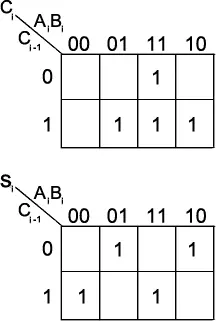
Click or tap the map to enlarge it.
Key Takeaways
- The 1Bit Fulladder Kmap is an essential tool in digital circuit design.
- It helps simplifying and optimizing logical expressions for sum and carry outputs in a full-adder circuit.
- Understanding the structure and functions of the 1Bit Fulladder Kmap is crucial for efficient circuit design.
History
The 1Bit Fulladder Kmap, also known as the 1-Bit Full Adder Karnaugh Map, was introduced by Maurice Karnaugh in 1953. Karnaugh maps, commonly referred to as K-Maps, are graphical tools used to simplify logical expressions and minimize the complexity of digital circuits.
Karnaugh maps are particularly useful for optimizing the sum and carry outputs in full-adder circuits. The 1Bit Fulladder Kmap specifically focuses on a single-bit full-adder, which is a basic building block in many digital systems.
Unique Insights
- The 1Bit Fulladder Kmap is a powerful visualization tool that helps engineers optimize digital circuits.
- It allows for the grouping of logical expressions based on adjacent cells in the map, which simplifies the overall circuit design.
- By reducing the number of gates required and decreasing propagation delays, the 1Bit Fulladder Kmap enhances the overall performance of digital systems.
Relevant Facts
| Year | Event |
|---|---|
| 1953 | Maurice Karnaugh introduces the Karnaugh map. |
| 1963 | The 1Bit Fulladder Kmap is extensively used in digital circuit design. |
| 1980s | Advancements in computer-aided design (CAD) tools enable more complex KMAP analysis. |
FAQ
1. What is a Karnaugh map?
A Karnaugh map, or K-Map, is a graphical representation of a truth table that helps simplify logical expressions in digital circuits.
2. How does the 1Bit Fulladder Kmap work?
The 1Bit Fulladder Kmap works by visually grouping adjacent cells with similar binary values, allowing for simplified logical expressions.
3. What are the benefits of using a Karnaugh map?
Using a Karnaugh map helps minimize the number of gates required, reduces circuit complexity, and improves overall circuit performance.
4. Are Karnaugh maps suitable for larger circuits?
Yes, Karnaugh maps can be used for circuits of various sizes. However, for large circuits, computer-aided design (CAD) tools are often utilized.
5. Can the 1Bit Fulladder Kmap be used in other applications?
The 1Bit Fulladder Kmap is specifically designed for optimizing single-bit full-adder circuits but can be extended to more complex circuits with multiple bits.
6. What are the limitations of Karnaugh maps?
Karnaugh maps become less practical for circuits with a large number of inputs, as visualization and manual optimization become challenging.
7. Are there any software tools available for K-Map analysis?
Yes, there are various software tools available, such as Boolean algebra calculators and dedicated Karnaugh map solvers, to aid in circuit optimization.
External Links
LSI Keywords
- Full-adder Karnaugh map
- K-Map optimization
- Binary circuit simplification
- Logic design
- Boolean algebra
- Digital system optimization
- Sum and Carry outputs
- Propagation delays
- Logical expressions
- Digital circuit design