Anglozanzibar War Map
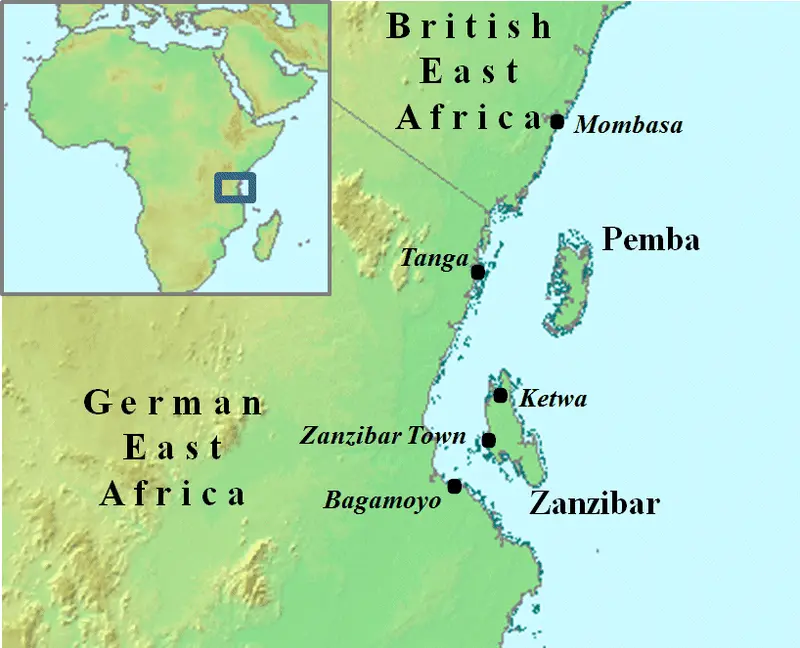
Click or tap the map to enlarge it.
Anglo-Zanzibar War Map
Key Takeaways
- The Anglo-Zanzibar War was the shortest recorded war in history, lasting only 38 minutes.
- This conflict took place between the British Empire and the Sultanate of Zanzibar and Oman on August 27, 1896.
- The war was triggered by the succession dispute following the death of the pro-British Sultan Khalid bin Barghash.
- The British forces launched a surprise attack on the Zanzibari palace and quickly neutralized resistance.
- The outcome of the war solidified British influence and control over Zanzibar, making it a protectorate until it gained independence in 1963.
History
The Anglo-Zanzibar War of 1896 was a significant event that unfolded in East Africa. The war erupted due to a succession dispute in Zanzibar following the death of Sultan Khalid bin Barghash, who had been supported by the British Empire. The British favored Hamoud bin Mohammed, a candidate more compliant with their interests, as the rightful successor.
On August 26, 1896, Sultan Hamoud officially declared himself the new ruler. However, Khalid and his supporters refused to accept the decision, barricading themselves inside the Zanzibari palace. Fearing further resistance, the British took immediate action to protect their influence and control over Zanzibar.
The British High Commissioner, Sir Basil Cave, issued an ultimatum to Khalid, ordering him to abdicate the throne by 9:00 a.m. the following day or face dire consequences. While diplomatic negotiations were underway, the British fleet stationed in Zanzibar‘s harbor prepared for a potential conflict.
With the deadline approaching, it became clear that Khalid had no intention of surrendering. At around 9:02 a.m. on August 27, 1896, the British forces commenced a swift attack on the palace. Despite possessing superior firepower and military strategy, the British soldiers faced some resistance from Khalid’s supporters who had managed to secure a few positions within the palace.
However, the Zanzibari defense was no match for the overwhelming might of the British Empire. The intense bombardment from British warships and a contingent of pro-Hamoud Zanzibari troops quickly silenced the opposition within a matter of minutes. By 9:40 a.m., the surviving members of Khalid’s force surrendered, effectively ending the war.
The short duration of the war earned it the title of the shortest recorded war in history, lasting only 38 minutes from the time the first shot was fired until the formal surrender. The result was a resounding victory for the British Empire and the establishment of direct control over Zanzibar.
Unique Insights
1. Rapid British Response: The swift attack on the palace showcases the strategic preparedness and quick response of the British Empire in protecting its interests.
2. British Naval Superiority: The presence of British warships in Zanzibar‘s harbor played a crucial role in neutralizing the Zanzibari resistance, demonstrating the empire’s military dominance at sea.
3. Impact on Zanzibar: The outcome of the war solidified British control over Zanzibar, shaping the region’s political landscape for the next several decades.
Table of Facts
| Date | Event |
|---|---|
| August 26, 1896 | Declaration of Sultan Hamoud as the new ruler |
| August 27, 1896 | British attack on the Zanzibari palace |
| August 27, 1896 | Formal surrender of Khalid’s supporters |
Frequently Asked Questions (FAQ)
Q1: Why was there a succession dispute in Zanzibar?
A1: The succession dispute arose due to conflicting interests between the British Empire and the supporters of the late Sultan Khalid bin Barghash.
Q2: How did the British forces respond to the dispute?
A2: The British forces quickly launched an attack on the Zanzibari palace to ensure their favored candidate, Hamoud bin Mohammed, could assume power.
Q3: What was the outcome of the Anglo-Zanzibar War?
A3: The British achieved a decisive victory, solidifying their control over Zanzibar and establishing it as a protectorate.
Q4: How long did the war last?
A4: The war lasted an incredibly short duration of only 38 minutes, making it the shortest recorded war in history.
Q5: Were there any casualties during the conflict?
A5: While some resistance was encountered, the casualties on both sides were relatively low compared to conventional warfare.
Q6: How did the war impact Zanzibar‘s future?
A6: The war solidified British influence and control over Zanzibar, shaping the region’s political landscape until it gained independence in 1963.
Q7: What role did British naval forces play in the war?
A7: British warships stationed in Zanzibar‘s harbor provided critical support during the attack and effectively neutralized the Zanzibari resistance.