Map of the Gupta Empire
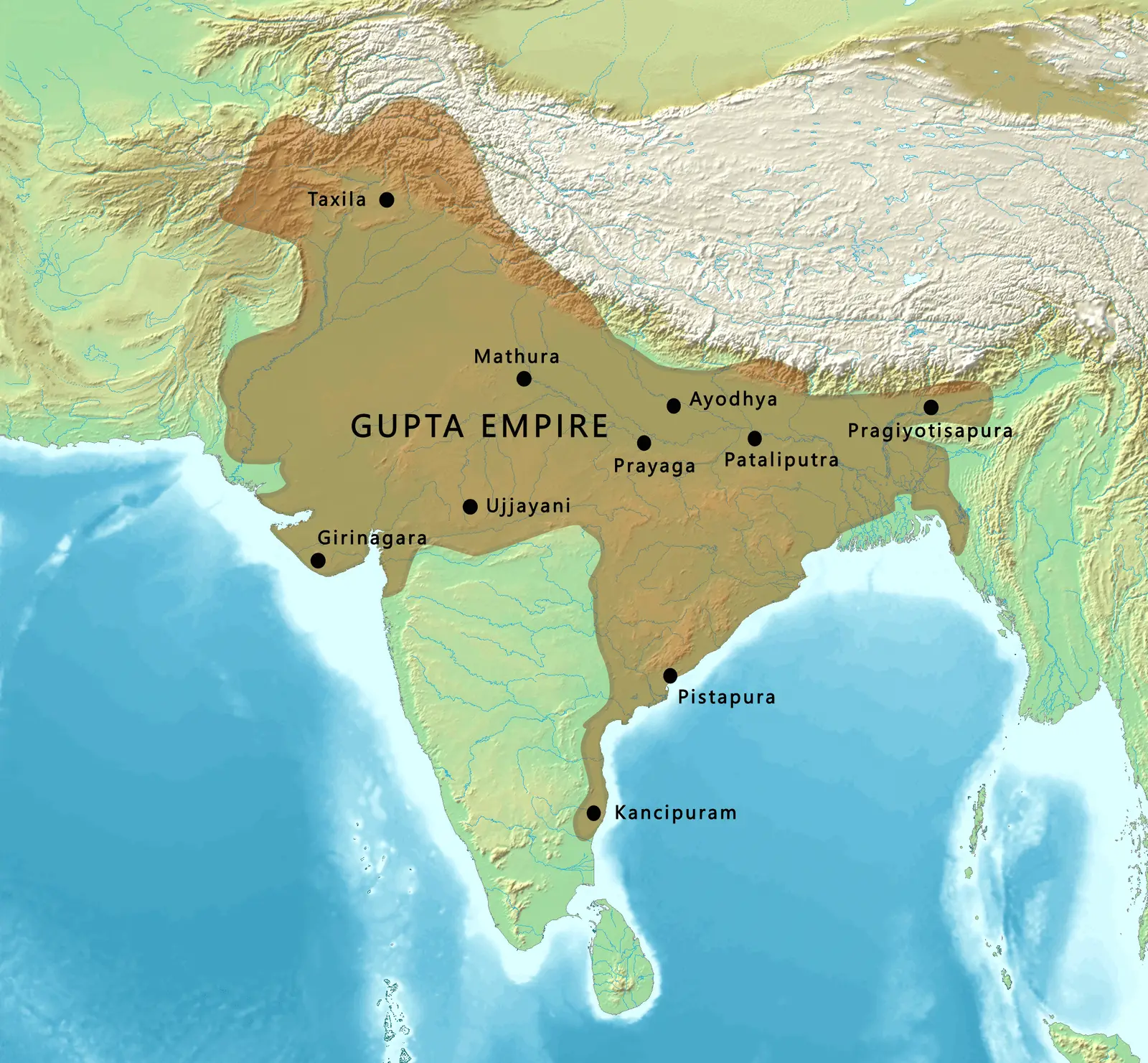
Click or tap the map to enlarge it.
Key Takeaways
- The Gupta Empire was an ancient Indian empire that existed from approximately 240 to 590 CE.
- The empire was known for its cultural achievements and economic prosperity.
- Gupta Empire’s territory spanned across a substantial portion of the Indian subcontinent.
- Arts, sciences, and literature flourished during the Gupta period.
- The empire ultimately declined due to internal conflicts and invasions by outside forces.
History of the Gupta Empire
The Gupta Empire, also referred to as the Golden Age of India, emerged in 240 CE and lasted until 590 CE. It is widely recognized as a time of great socio-cultural development, political stability, and economic prosperity in ancient India.
The empire was founded by Sri Gupta and reached its peak under the reign of Chandragupta I, Samudragupta, and Chandragupta II. They successfully expanded the empire’s territory and established a strong centralized administration system.
Unique Insights
During the Gupta period, India made significant advancements in various fields. Some unique insights include:
- Arts and Architecture: Gupta art and architecture flourished, characterized by intricate sculptures and beautifully designed temples.
- Mathematics and Astronomy: Indian mathematicians made substantial progress, with Aryabhata introducing the concept of zero.
- Literature and Education: Renowned works such as Kalidasa’s plays and the compilation of the Mahabharata took place during this era.
- Medical Science: Ayurveda, an ancient Indian system of medicine, saw remarkable developments.
- Trade and Economy: The Gupta Empire established prosperous trade routes, which significantly boosted their economy.
Table: Relevant Facts during the Gupta Empire
| Year | Event |
|---|---|
| 320 CE | Chandragupta I establishes the Gupta Empire. |
| 375 CE | Reign of Samudragupta, known as the “Napoleon of India.” |
| 380 CE | Alliance with Vakataka Dynasty. |
| 380-415 CE | Reign of Chandragupta II, known as Vikramaditya. |
| 452-486 CE | Reign of Kumaragupta I. |
| 480-540 CE | Reign of Skandagupta. |
| 590 CE | The decline of the Gupta Empire. |
Frequently Asked Questions (FAQ)
-
What was the territorial extent of the Gupta Empire?
The Gupta Empire encompassed a substantial portion of the Indian subcontinent, including present-day India, Pakistan, and Bangladesh.
-
What led to the decline of the Gupta Empire?
The decline of the Gupta Empire can be attributed to internal conflicts among nobles, weak successors, provincial governors asserting independence, and invasions by the Huna people.
-
What were the major achievements of the Gupta Empire?
The Gupta Empire witnessed remarkable achievements in art, science, literature, mathematics, agriculture, and medicine. It was a time of immense cultural and intellectual growth.
-
Who were some notable rulers of the Gupta Empire?
Chandragupta I, Samudragupta, Chandragupta II (Vikramaditya), Kumaragupta I, and Skandagupta were some notable rulers of the Gupta Empire.
-
What were the contributions of the Gupta period to mathematics?
The Gupta period led to the development of the decimal system, advancements in algebra, and notable scholars like Aryabhata and Brahmagupta.
-
Did the Gupta Empire promote trade?
Yes, the Gupta Empire actively promoted trade through the establishment of trade routes and the use of coins for currency, contributing to economic prosperity.
-
What is the significance of the Gupta Empire in Indian history?
The Gupta Empire is considered a significant period in Indian history due to its cultural, scientific, and economic achievements, which shaped future developments.