Ussr Map
Key Takeaways
- The USSR, also known as the Soviet Union, was a socialist state that existed from 1922 to 1991.
- The USSR spanned over Eurasia and comprised fifteen republics.
- The USSR was the largest country in the world geographically.
- Mapping the USSR allows us to explore its diverse landscapes, cultural heritage, and political history.
History of the USSR
The USSR, officially known as the Union of Soviet Socialist Republics, was established on December 30, 1922. It was
a federation of fifteen Soviet republics located in Eurasia. The country spanned an enormous area, covering one-sixth
of the Earth’s land surface, making it the largest country in the world.
The USSR was founded after the Russian Revolution of 1917, which overthrew the Russian monarchy and led to the rise
of the Bolshevik party. The new government aimed to create a classless society based on socialism, promoting the
principles of equality and communal ownership.
Throughout its existence, the USSR experienced significant political, social, and economic changes. It played a
crucial role in World War II as one of the Allied powers, leading to its emergence as a superpower alongside the
United States. However, internal struggles, economic inefficiencies, and political repression eventually led to its
collapse in 1991.
Unique Insights
Exploring the USSR map allows us to gain unique insights into its diverse landscapes, cultural heritage, and
political history. Here are some notable insights:
- The USSR encompassed a wide range of geographical features, including vast plains, expansive forests, arctic
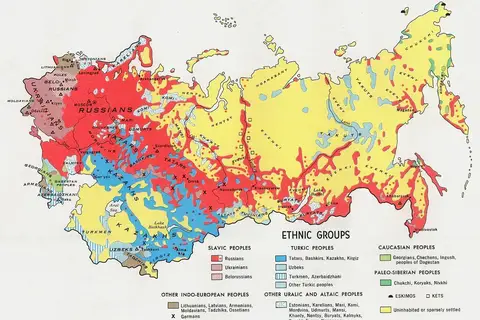
tundra, deserts, and mountain ranges. Each region had its own distinct characteristics and resources. - The USSR comprised a rich tapestry of cultures, languages, and ethnicities. From Slavic to Turkic, the diverse
population contributed to the country’s unique identity. - The USSR was home to numerous UNESCO World Heritage Sites, such as the Kremlin and Red Square in Moscow, the
historic center of Saint Petersburg, and the ancient city of Samarkand in Uzbekistan. - The USSR’s political history was marked by the rise and fall of leaders such as Vladimir Lenin, Joseph Stalin,
and Mikhail Gorbachev, each leaving a lasting impact on the country and its people.
Relevant Facts about the USSR
| Year | Event |
|---|---|
| 1922 | The USSR is formally established as a federation of Soviet republics. |
| 1941-1945 | The USSR plays a crucial role in World War II, resisting the German invasion and contributing to the defeat of Nazi Germany. |
| 1957 | The Soviet Union launches the first artificial satellite, Sputnik 1, marking the beginning of the Space Age. |
| 1986 | The Chernobyl nuclear disaster occurs in present-day Ukraine, causing significant environmental and health impacts. |
| 1991 | The USSR collapses, leading to the establishment of independent states across its territory. |
Frequently Asked Questions (FAQ)
-
What was the USSR?
The USSR (Union of Soviet Socialist Republics) was a socialist state that existed from 1922 to 1991. It was a federation
of fifteen Soviet republics spanning across Eurasia. -
What countries were part of the USSR?
The USSR comprised fifteen Soviet republics, including Russia, Ukraine, Belarus, Uzbekistan, Kazakhstan, and others.
-
What led to the collapse of the USSR?
Several factors contributed to the collapse of the USSR, including economic struggles, political repression, and the
desire for independence among the constituent republics. -
Why is the USSR significant in history?
The USSR played a crucial role in World War II as one of the Allied powers, resisting the German invasion and
contributing to the defeat of Nazi Germany. It also emerged as a superpower alongside the United States during the
Cold War. -
What are some famous landmarks in the USSR?
Some famous landmarks in the USSR include the Kremlin and Red Square in Moscow, the historic center of Saint
Petersburg, and the ancient city of Samarkand in Uzbekistan. -
Who were the notable leaders of the USSR?
Notable leaders of the USSR include Vladimir Lenin, Joseph Stalin, Nikita Khrushchev, and Mikhail Gorbachev.
-
How did the USSR impact the world?
The USSR had a significant impact on world history, particularly during the Cold War era. Its ideological conflict
with the United States shaped global politics, leading to advancements in space exploration, arms race, and
geopolitical realignments.
External Links
- Wikipedia – Union of Soviet
Socialist Republics - Library of Congress – The Soviet Union
- BBC History – The End of the Soviet
Union
LSI Keywords
- USSR map
- Soviet Union
- Socialist state
- Bolshevik party
- Superpower
- Cultural diversity in USSR
- UNESCO World Heritage Sites in USSR
- Vladimir Lenin
- Joseph Stalin
- Mikhail Gorbachev
- Rise and fall of the USSR