Greater Israel Map
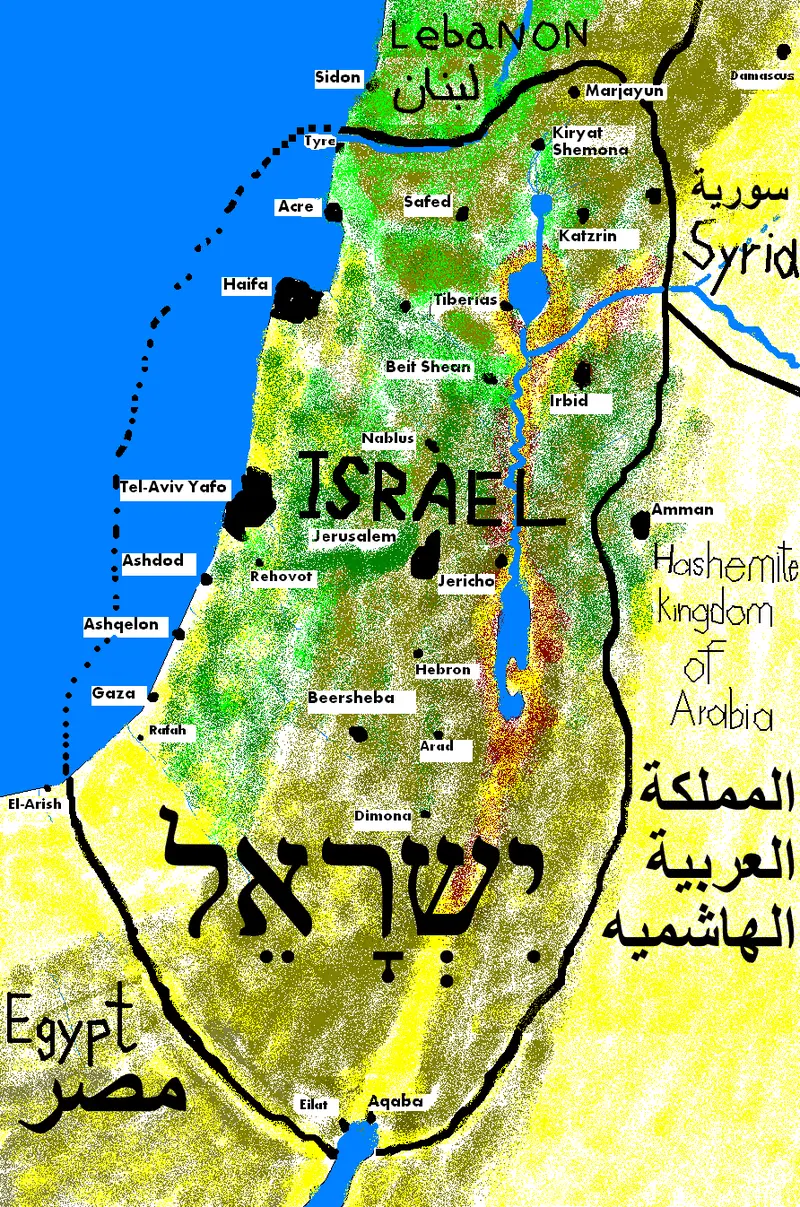
Click or tap the map to enlarge it.
Key Takeaways
- The Greater Israel Map represents a geopolitical concept that envisions Israel’s expansion beyond its current borders.
- It is a controversial topic as it promotes territorial expansion and has significant political and cultural implications.
- The concept of a Greater Israel has historical and religious roots, shaping its significance.
History
The Greater Israel Map is a term used to describe the idea of expanding the borders of the State of Israel to encompass territories beyond its current boundaries. The concept has historical and religious significance, attracting both support and criticism.
Origin of the Greater Israel Concept
The roots of the Greater Israel concept can be traced back to the biblical times when the Israelites occupied a larger territory compared to modern Israel. The term “Eretz Israel” (Land of Israel) first appeared in religious texts and referred to the territory promised to the Israelites by God.
The concept gained prominence during the 20th century when Zionists, who sought to establish a Jewish homeland, started advocating for the reclamation of historic Jewish territories. The term “Greater Israel” emerged to describe the envisioned expansion.
Controversy and Political Implications
The Greater Israel concept has been highly controversial and politically charged, generating debates both within Israel and internationally. Supporters argue that it is a legitimate claim based on biblical and historical connections to the land.
However, critics argue that it poses significant challenges to achieving a peaceful resolution to the Israeli-Palestinian conflict and may undermine prospects for a two-state solution. Many believe that the pursuit of a Greater Israel would lead to continued tensions with neighboring countries and perpetuate the cycle of violence in the region.
Unique Insights
Exploring the Greater Israel Map provides several unique insights:
- The concept of a Greater Israel has deep historical and religious roots, shaping its significance in the present.
- The controversy surrounding the Greater Israel idea arises from its potential political ramifications and implications for peace negotiations.
- The Greater Israel Map represents a territorial expansion that extends beyond the internationally recognized borders of Israel.
- Supporters argue that the concept reflects the historical connection of Jewish people to the region.
- Critics express concerns over the potential consequences of pursuing a Greater Israel, such as ongoing conflicts and destabilization of the region.
Table of Relevant Facts
| Year | Event |
|---|---|
| 1948 | Establishment of the State of Israel |
| 1967 | Six-Day War, Israel captures the Sinai Peninsula, West Bank, Gaza Strip, and the Golan Heights |
| 1978 | Israel-Egypt Peace Treaty signed, leading to the return of Sinai Peninsula to Egypt |
Frequently Asked Questions (FAQ)
1. What is the Greater Israel Map?
The Greater Israel Map represents the concept of expanding Israel’s territory beyond its current borders.
2. What are the historical roots of the Greater Israel idea?
The concept finds its origins in biblical times when the Israelites occupied a larger territory in the region.
3. What are the political implications of pursuing a Greater Israel?
Pursuing a Greater Israel can hinder peace negotiations and potentially lead to further conflict with neighboring countries.
4. Is the Greater Israel concept universally accepted within Israel?
No, the concept has both supporters and critics within Israel, contributing to ongoing debates and discussions.
5. Has Israel ever expanded its territory since its establishment?
Israel has captured territories in wars and returned some, like the Sinai Peninsula, as part of peace treaties.
6. How does the Greater Israel concept impact the Israeli-Palestinian conflict?
The concept complicates efforts to find a peaceful resolution and establish a viable Palestinian state alongside Israel.
7. Are there any alternatives to the Greater Israel idea?
Yes, various proposals, including the two-state solution, have been suggested to address the Israeli-Palestinian conflict.