Hinduism as a Share of Population: World Map
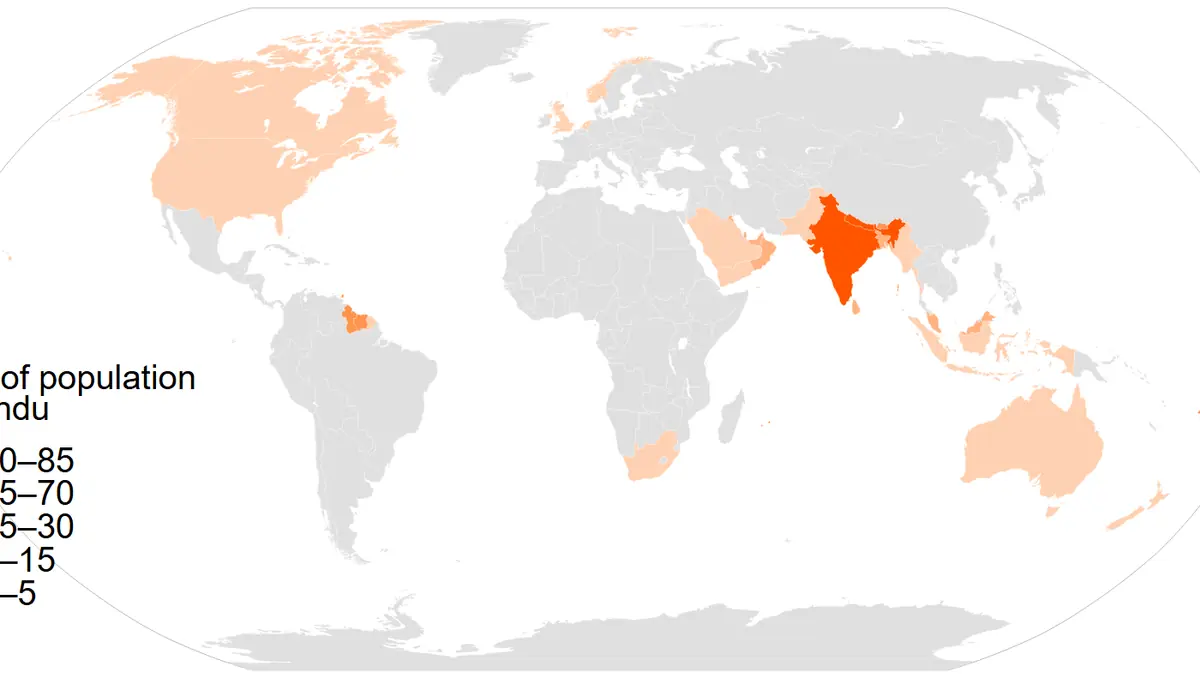
Click or tap the map to enlarge it.
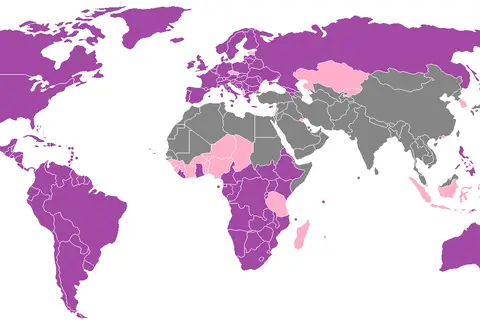
This world map shades each country by the share of its population that is Hindu, using data from the Pew Research Center. Most of the dark shading is in South Asia, with smaller concentrations elsewhere along old trade and migration routes.
Globally there were just over one billion Hindus around 2010, about 15 per cent of the world's population, and roughly 94 per cent of them lived in India.
Beyond India
Nepal has the highest share in the world after India, at around 81 per cent. Mauritius, with a population descended largely from Indian indentured labourers, is about half Hindu. Smaller but significant Hindu communities exist in Sri Lanka, Bangladesh, Bhutan, Fiji, Guyana, Trinidad and Tobago, Suriname and Bali in Indonesia. Large diaspora communities live in the United Kingdom, the United States, Canada and the Gulf states.
Historical migration explains this pattern: labour migration under British colonial rule, trading networks across the Indian Ocean, and more recent emigration for work and study.
Reading the shading
A percentage map does not tell you how many people live in each country, so a country with a large Hindu population but a small share, such as the United States, may look pale. Pew's figures draw on censuses and large surveys, and religious identity can be difficult to measure in places where Hinduism overlaps with other practices.
How the figures were produced
Pew built its estimates from national censuses, large demographic surveys and population registers. Hindus are easiest to count in India and Nepal, where census questions ask about religion directly. In countries where religion is not recorded, researchers rely on surveys, so the numbers carry more uncertainty. The base year is around 2010, which means the map predates more recent migration. Pew's later projections suggested that Hindus would remain close to 15 per cent of the world's population in 2050.
Key facts
| Country | Approximate share |
|---|---|
| Nepal | 81% |
| India | 80% |
| Mauritius | 48% |
| Sri Lanka | 13% |
| Bangladesh | 9% |
Questions about this map
Where do most Hindus live?
About 94 per cent live in India.
Who produced the data?
Pew Research Center.
Why is Bali Hindu?
Hinduism arrived with Indian influence in early Indonesian history and survived on Bali after Islam spread across the other islands.