Religious Map of Montenegro by Municipality
Click or tap the map to enlarge it.
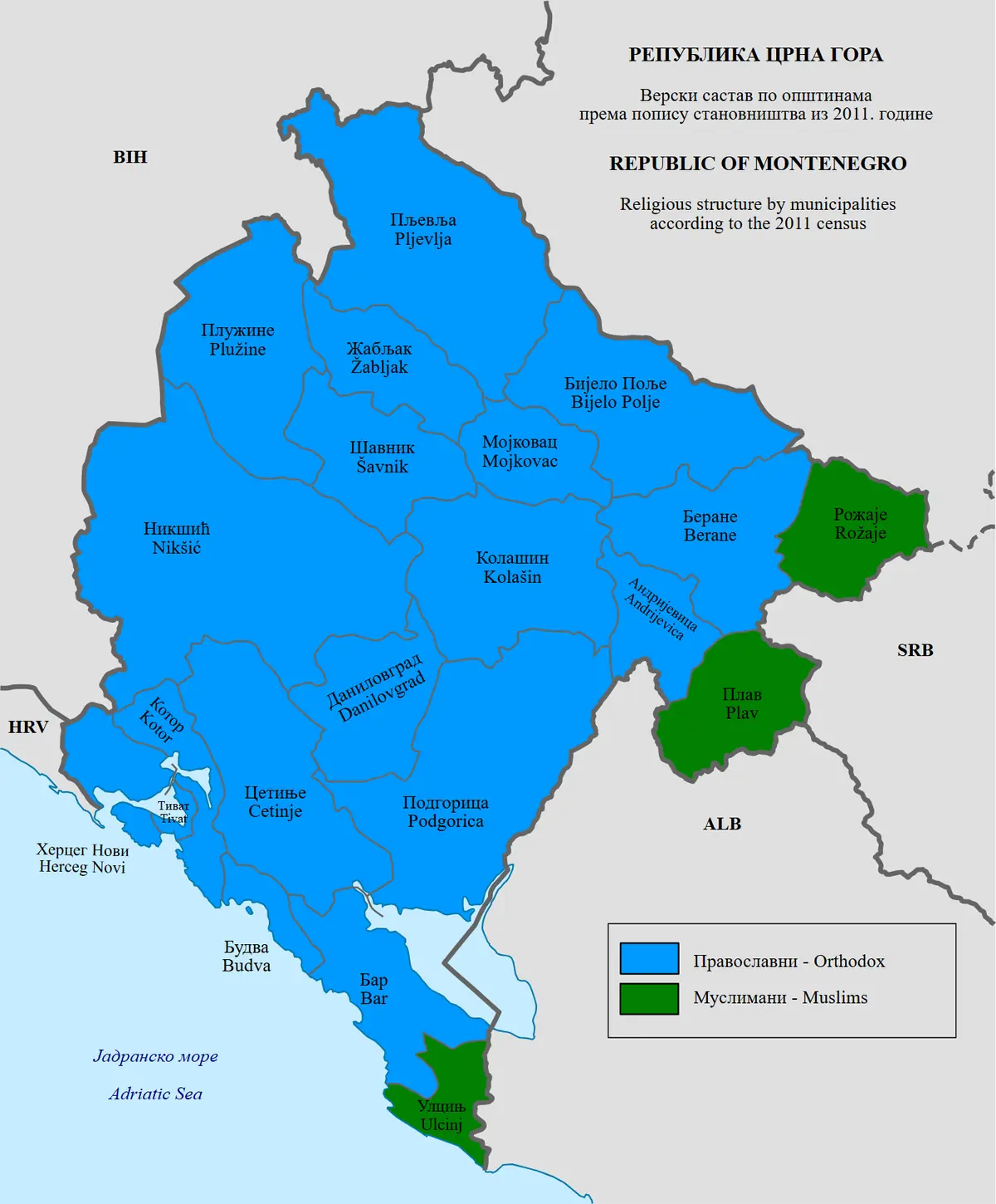
This map of Montenegro shows the main religion in each municipality, with labels in English and in the Serbian, Montenegrin and Bosnian languages. It follows the pattern in the 2011 census, which counted about 620,000 residents.
Montenegro is a small Balkan country on the Adriatic coast, and its religious map is closely tied to ethnic geography and to the Ottoman period.
The pattern by municipality
In 2011 about 72 per cent of Montenegrins said they were Orthodox Christian, about 19 per cent Muslim and about 3 per cent Catholic. Orthodox Christians form the majority in most municipalities, especially in the centre and north-west. Muslims are the largest group in municipalities along the eastern borders, such as Rožaje, Plav and Ulcinj, and form a large share in places like Bijelo Polje and Tuzi. Catholics are concentrated in the coastal Bay of Kotor and around Tivat and Bar.
These areas correspond to different histories. The coast was long under Venetian rule, which brought a Catholic population, while the interior and east experienced Ottoman rule.
Municipality maps and their limits
A map showing the largest group per municipality simplifies the situation. Many municipalities have mixed populations, and boundaries have changed since 2011 as new municipalities were created. Montenegro became independent from Serbia in 2006, and the census figures are the most recent detailed source.
Religion and identity
In Montenegro, religion overlaps with language and national identity. The 2011 census recorded Montenegrins at about 45 per cent of the population, Serbs at about 29 per cent, Bosniaks at about 9 per cent and Albanians at about 5 per cent. Most Orthodox Christians belong to the Serbian Orthodox Church, while the Montenegrin Orthodox Church, which is not recognised by other Orthodox churches, claims a smaller following. A municipality map by religion therefore reflects a political and cultural landscape as well as belief.
Key facts
| Religion | Share |
|---|---|
| Orthodox Christian | About 72% |
| Muslim | About 19% |
| Catholic | About 3% |
| Population | About 620,000 |
Questions about this map
When did Montenegro become independent?
In 2006, after a referendum.
Where do most Catholics live?
In the coastal region around the Bay of Kotor and Bar.
Where does the data come from?
The 2011 census of Montenegro.