Malt Whisky Flavor Map
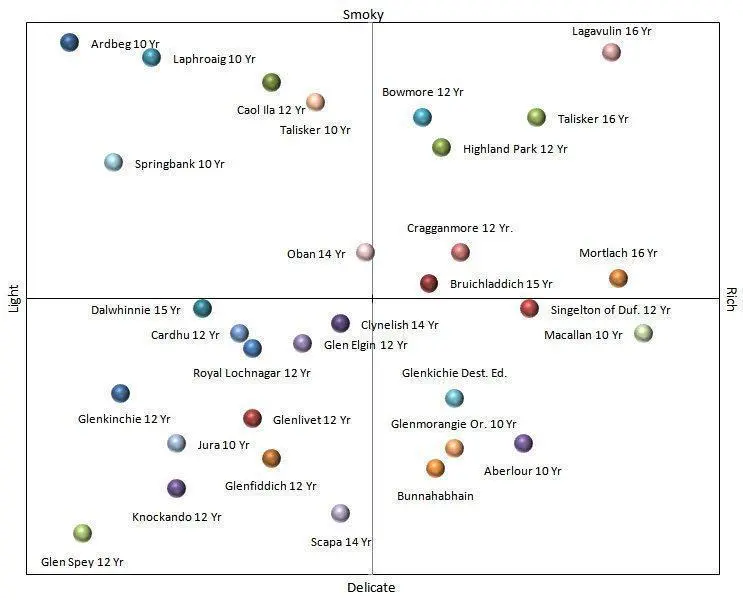
Click or tap the map to enlarge it.
Key Takeaways
- The Malt Whisky Flavor Map categorizes whiskies based on their distinct flavor profiles.
- Understanding the map helps whisky enthusiasts explore different styles and find their preferred taste.
- Whisky distilleries across various regions produce distinct flavors influenced by their local climate and ingredients.
History of the Malt Whisky Flavor Map
The Malt Whisky Flavor Map is a popular tool that has been embraced by whisky lovers around the world. It was created to simplify the complex world of malt whisky and guide enthusiasts in their exploration of diverse flavors.
The concept of mapping whisky flavors emerged in the late 20th century when experts realized the need to describe the vast range of flavors found in malt whiskies. Traditional descriptions such as “peaty,” “spicy,” or “sweet” were insufficient to capture the intricacies of different whiskies.
In 2014, the Scotch Whisky Research Institute (SWRI) collaborated with whisky experts, distillers, and sensory scientists to develop the Malt Whisky Flavor Map. This comprehensive map organizes whisky into four quadrants, each representing a different flavor characteristic.
The Malt Whisky Flavor Map has since become an essential reference for distilleries, retailers, and whisky enthusiasts alike, providing a standardized language to discuss and categorize whisky flavors.
Unique Insights
The Malt Whisky Flavor Map offers unique insights into the world of whisky flavors. Here are some key insights:
- 1. Flavor categorization: The map divides malt whiskies into four quadrants based on two factors – the degree of smokiness and the level of sweetness. The quadrants include “Light & Delicate,” “Rich & Fruity,” “Rich & Spicy,” and “Peaty & Smoky.”
- 2. Regional influences: Each quadrant on the map represents whisky styles predominantly associated with specific regions. For example, “Light & Delicate” whiskies are often connected with the Lowlands of Scotland, while “Peaty & Smoky” whiskies are commonly found in Islay.
- 3. Exploring preferences: Whisky enthusiasts can identify their preferred flavors by referring to the Malt Whisky Flavor Map. By pinpointing their favored quadrant, they can gradually explore whiskies within that category, expanding their knowledge and palate.
- 4. Personalized recommendations: The Malt Whisky Flavor Map also enables experts to recommend new whiskies to individuals based on their preferences. By understanding a person’s taste preferences, experts can suggest whiskies from other quadrants that share similar flavor profiles.
Table: Significant Facts about Malt Whisky Flavor Map
| Year | Significant Event |
|---|---|
| 2014 | Development of the Malt Whisky Flavor Map by SWRI in collaboration with experts. |
| 2015 | Official release and publication of the Malt Whisky Flavor Map. |
| 2016 | Judging panels at whisky competitions begin using the Malt Whisky Flavor Map for evaluation. |
| 2018 | Online platforms start incorporating the Malt Whisky Flavor Map to enhance user experiences. |
| 2019 | The Malt Whisky Flavor Map becomes a reference tool for whisky education programs globally. |
Frequently Asked Questions (FAQ)
1. How can the Malt Whisky Flavor Map help me choose a whisky?
Answer: The Malt Whisky Flavor Map provides a visual representation of different flavor profiles, helping you identify whiskies that align with your taste preferences. It allows you to explore various styles and find your preferred whisky flavor.
2. Are the flavor quadrants on the map fixed or subjective?
Answer: While the Malt Whisky Flavor Map provides a standardized framework, it’s important to note that flavor perception can be subjective. The map serves as a general guide, and individual interpretations may vary to some extent.
3. Can a whisky fall into multiple quadrants?
Answer: No, each particular whisky is typically associated with one quadrant on the map based on its dominant flavor characteristics. However, there can be subtle variations and interplay of flavors within a specific quadrant.
4. Does the Malt Whisky Flavor Map include all whiskies worldwide?
Answer: The Malt Whisky Flavor Map primarily focuses on Scotch whiskies. While it may provide insights into other types of whiskies, its categorizations are primarily applicable to Scotch whiskies produced in different regions of Scotland.
5. Can the Malt Whisky Flavor Map be used for other types of spirits?
Answer: The Malt Whisky Flavor Map was specifically designed for whisky and might not be directly applicable to other spirits or alcoholic beverages. However, the general concept of flavor categorization can be adapted for other products.
6. Are there any plans to expand the Malt Whisky Flavor Map?
Answer: The Malt Whisky Flavor Map is regularly reviewed, allowing for necessary updates and expansions. As the whisky industry evolves and new flavors emerge, there may be plans to refine and expand the map in the future.
7. Can I download a copy of the Malt Whisky Flavor Map?
Answer: Yes, the Malt Whisky Flavor Map is available for download on the official website of the Scotch Whisky Research Institute (SWRI). It can be used for personal reference or educational purposes.